Surgical Technology & Safety

Why our results are different.

Three technical decisions, applied consistently in every single surgery — not as an occasional upgrade, but as the standard of practice.

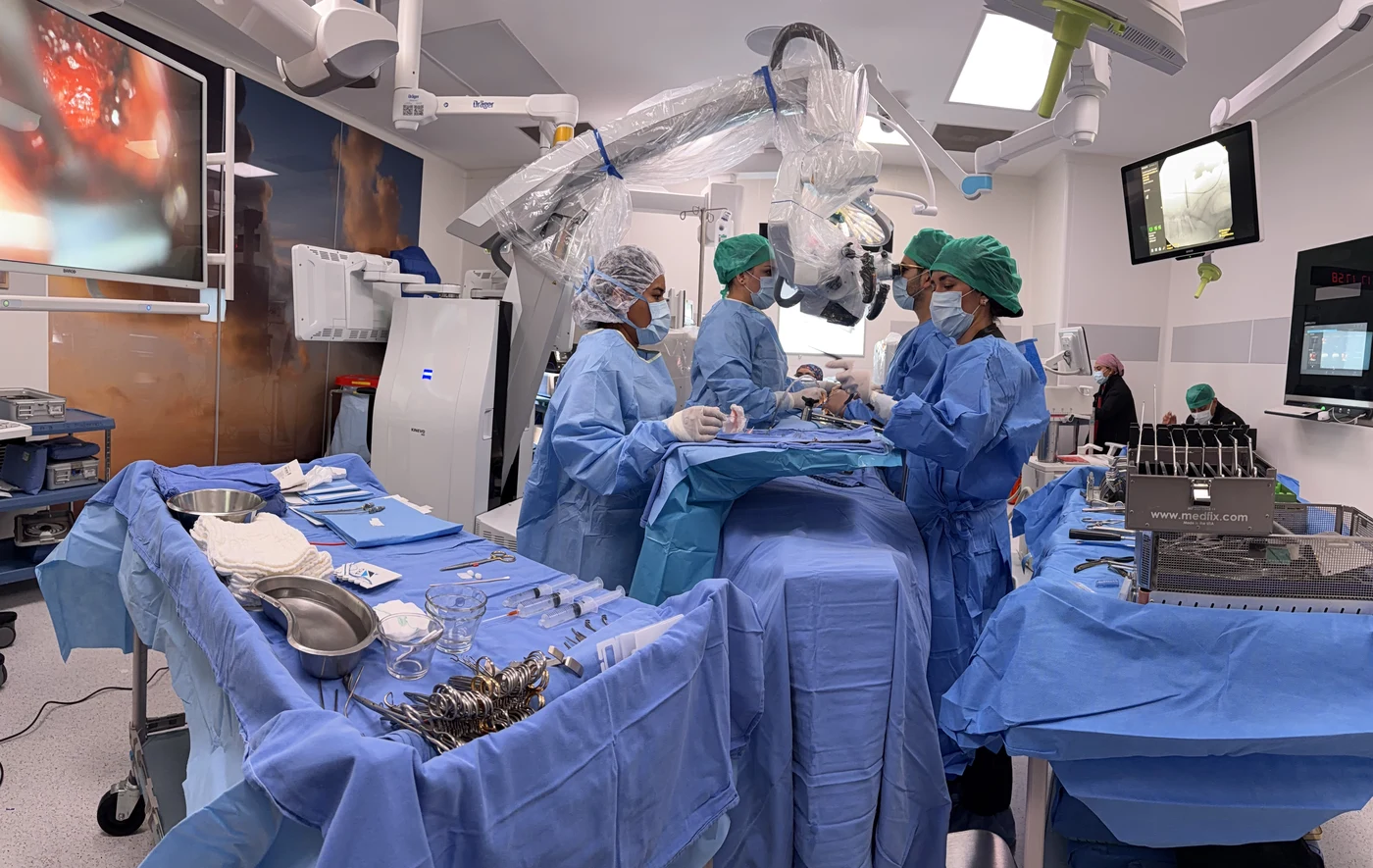
Cirugía de columna con microscopio quirúrgico y monitoreo neurofisiológico intraoperatorio — CICOVE, Ciudad de México
Precision
Microsurgery in every case
Every procedure is performed under a surgical microscope, which provides magnification and illumination the naked eye cannot match. This allows for smaller incisions, more precise identification of nerve roots and dura, and less disruption of surrounding muscle and tissue. It is not an optional add-on for complex cases — it is used in every spine surgery performed, primary or revision.
Read more →
Recovery
MIS technique, even in revisions when possible
Minimally invasive surgery (MIS) uses smaller incisions and specialized retractors instead of the wide muscle-stripping approach of traditional open surgery. This generally means less blood loss, less postoperative pain, and a faster return to daily activity. Revision surgery is technically harder to perform through a minimally invasive approach because of scar tissue from the prior operation — but when the anatomy allows it, it remains the preferred technique, not just for first-time surgery.
Read more →
Safety
IONM in 100% of spine surgeries
Intraoperative neurophysiological monitoring (IONM) tracks the electrical signals of the spinal cord and nerve roots continuously throughout surgery, in real time. If a signal changes, the surgical team knows immediately and can adjust the approach right away. Neuromonitoring helps identify potentially relevant physiological changes; it does not guarantee that a neurological injury will be avoided. This is standard practice for every spine surgery performed here — not reserved only for the highest-risk cases.
Se usa en el 100% de los casos
Read more →
Have questions about your case?

Send your imaging for a free pre-evaluation.

Contact us →