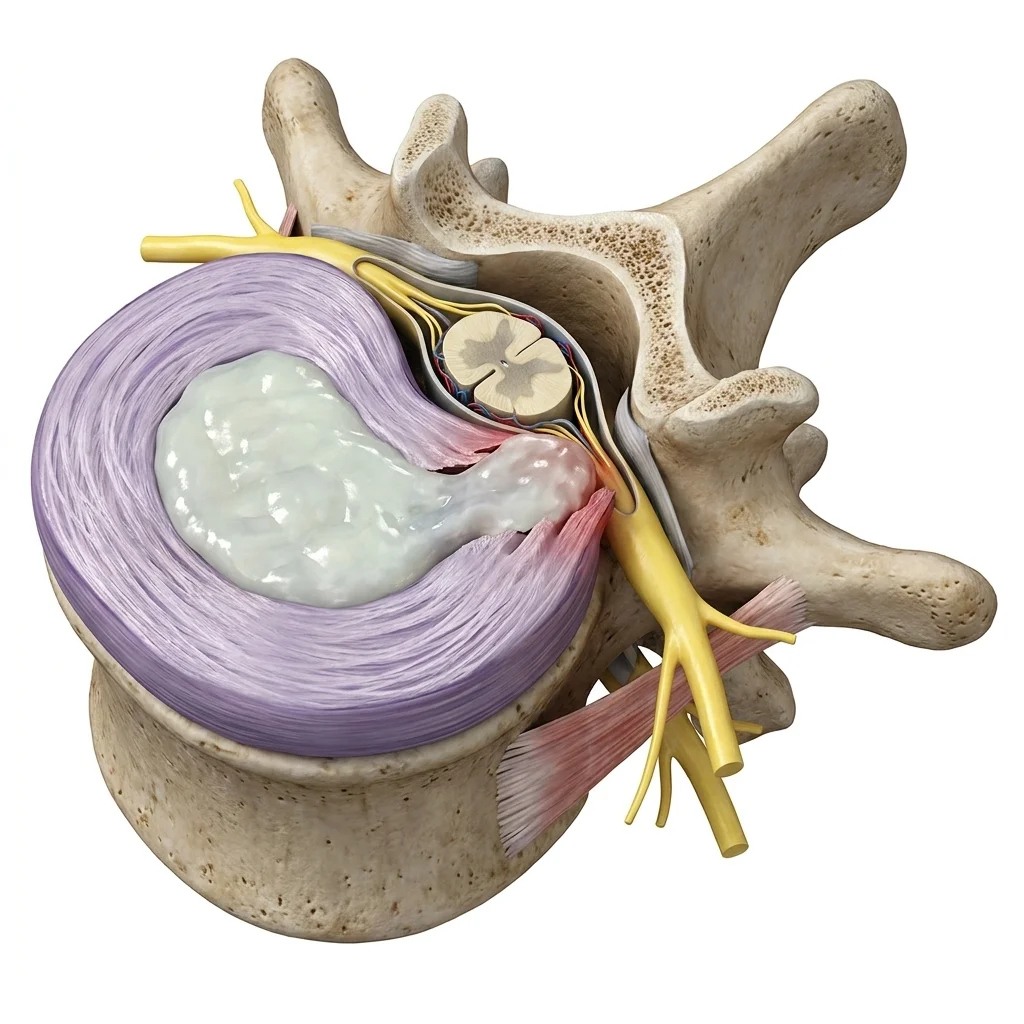
- What is a lumbar disc herniation?
- How common is it?
- What are the risk factors?
- What symptoms does it cause?
- How is it diagnosed?
If you are reading this, you most likely already have a diagnosis of lumbar disc herniation, or someone has suggested it. There is a lot of contradictory information out there, much of it more alarming than useful. The goal of this article is to give you a clear, evidence-based picture of the disease, treatment options, and how to make a sensible decision with your physician — particularly when surgery is on the table.
Had spine surgery and the pain returned? Send your studies for a second opinion.
Send my studiesThe most current definition describes it as a localized displacement of intervertebral disc material that causes pain, numbness, or weakness in the distribution of a spinal nerve. In plain language: fragments of disc that have moved outside their normal position and are now producing symptoms.
Up to 80% of the population will have low back pain at some point in life. Lumbar disc herniation is the most common spine condition requiring surgical intervention, and the leading cause of sciatica. That said, not every herniation produces symptoms — what matters clinically is the size, location and configuration of the lesion, not its mere existence on an MRI.
Overweight and obesity are the most significant modifiable risk factors. Diabetes, elevated triglycerides and cholesterol also contribute, and smoking is a well-established risk factor in the literature. Occupational and lifestyle factors matter too: prolonged sitting, long periods of driving, and repetitive heavy lifting alter the normal biomechanics of the spine. Chronic stress has also been identified as a contributing factor in several studies.
The most common symptom is low back pain. Sciatica — pain radiating down the leg — is the most frequent radicular symptom and lumbar disc herniation is its most common cause. Patients can present with pain localized to the back, pain radiating to one or both legs, numbness, or loss of strength in specific muscle groups. Less commonly, there can be loss of urinary or fecal sphincter control — which constitutes a medical emergency requiring immediate evaluation. Erectile dysfunction occurs rarely.
Loss of bladder or bowel control, progressive weakness in the legs, or numbness in the perineal area (saddle anesthesia) are red flags. These suggest cauda equina syndrome and require urgent surgical evaluation — not waiting.
The clinical history and physical examination performed by a specialist remain the cornerstone of diagnosis. Imaging confirms what the exam suggests. Lumbosacral MRI is the most useful imaging study — it identifies the cause, evaluates the degree of nerve compression, and informs surgical planning. Electrophysiological studies (EMG, nerve conduction) can confirm nerve compression but do not show its cause or location, so their role is supportive rather than diagnostic.
Every case is different, and treatment must be individualized. For most patients, conservative treatment and lifestyle changes are the appropriate first step. Epidural steroid injections show modest, transient efficacy in carefully selected cases. There is no evidence that bed rest improves outcomes — quite the opposite. Non-steroidal anti-inflammatory drugs provide only modest pain relief.
When surgery is indicated, the most common procedures are microdiscectomy, open discectomy, and tubular discectomy. The advantages of minimally invasive techniques are clear: less blood loss, shorter operative time, shorter hospital stay, and faster recovery.
This is the million-dollar question, and I'll answer it without spin: there is no single, universal consensus. Current guidelines recommend waiting a maximum of 6 weeks if pain has not improved with conservative treatment. Operating before 3 months tends to produce better outcomes; waiting beyond 6 months tends to produce worse ones. Patient age, duration and severity of symptoms, the location and morphology of the herniation, and which motor nerves are affected all influence the decision.
One factor that is increasingly recognized in the literature is spontaneous disc resorption — the phenomenon by which a herniated fragment shrinks or disappears on its own without surgery. The reported incidence varies considerably between authors and across studies, depending on hernia morphology (sequestered and ruptured hernias resorb more often than contained ones), imaging follow-up window, and patient population. Recognizing that resorption is real and not rare is part of why waiting — when symptoms allow — is a legitimate option.
What is equally important to understand: without surgery, about 80% of patients recover motor strength and 50% recover sensation within 12 months. The severity of weakness at presentation reduces the likelihood of full recovery. The real question becomes: what will your life look like during those 12 months? This is usually a disease of working-age people and causes significant disability.
Surgery significantly improves pain and accelerates the return to daily activities. Patients can typically return to work within one week. Standard recovery time is about 4 weeks with surgery versus 12 weeks without. What if you're among the unlucky ones who don't recover strength or sensation? With sensation in particular, at 12 months it becomes close to a coin toss.
The decision is yours, made jointly with your physician based on the evidence above. Only you know how much pain you have and how much you can tolerate. Your overall health matters too — the risks and benefits go on a balance, and only you can weigh what matters most to you.
The principle is the same across all techniques: remove the disc fragments that are compressing the neural structures. My preferred technique is microdiscectomy (microsurgery), based on over 2,000 successfully operated patients. The incision size varies from 0.7 mm to 2.5 cm on average, depending on the chosen technique (mini-open, endoscopic, tubular), and the area worked on inside the body is smaller than the nail of your little finger. IONM (intraoperative neurophysiological monitoring) is used in 100% of cases to continuously monitor nerve function during the procedure.
Surgery takes approximately 90 minutes per disc level treated. The procedure can be performed on an outpatient basis with same-day discharge — though most patients prefer to spend one night in the hospital. You will walk and use the bathroom the same day of surgery. You can return to work in approximately 7 days. These are the practical advantages of a minimally invasive approach.
Complications are inherent to any procedure in daily life. Think about what could go wrong when you cross a street: you could trip, get hit by a car, or worse. But most of the time it doesn't happen because of all the preventive measures we take automatically. The same applies in surgery, except the preventive measures are more deliberate and a trained team verifies every step. Surgery is overall a safe procedure, and most complications have a solution.
- 1–3% Symptom exacerbation (more pain, additional sensory loss)
- ~5% Will not recover — regardless of whether surgery is performed
- 1–2% Wound complications: dehiscence, infection, or seroma
- 3% Dural tear
- 1/2,000 Mortality
Final reflection
Now that you are informed on the topic of lumbar disc herniation, you can make a thoughtful decision together with your physician. My best recommendation is to choose, whenever possible, a procedure that preserves spinal mobility — and to leave fixations (screws, rods, interbody spacers) as a last resort. Minimally invasive procedures have shown faster recovery compared with open surgery. Bear in mind that your surgeon will tend to suggest the technique they personally master best, in order to minimize risk.
The best decisions are made collaboratively. Everything in this article is drawn from the most authoritative sources in the field — don't hesitate to bring it to your appointment and discuss it with your doctor in detail.
Thank you for reading.